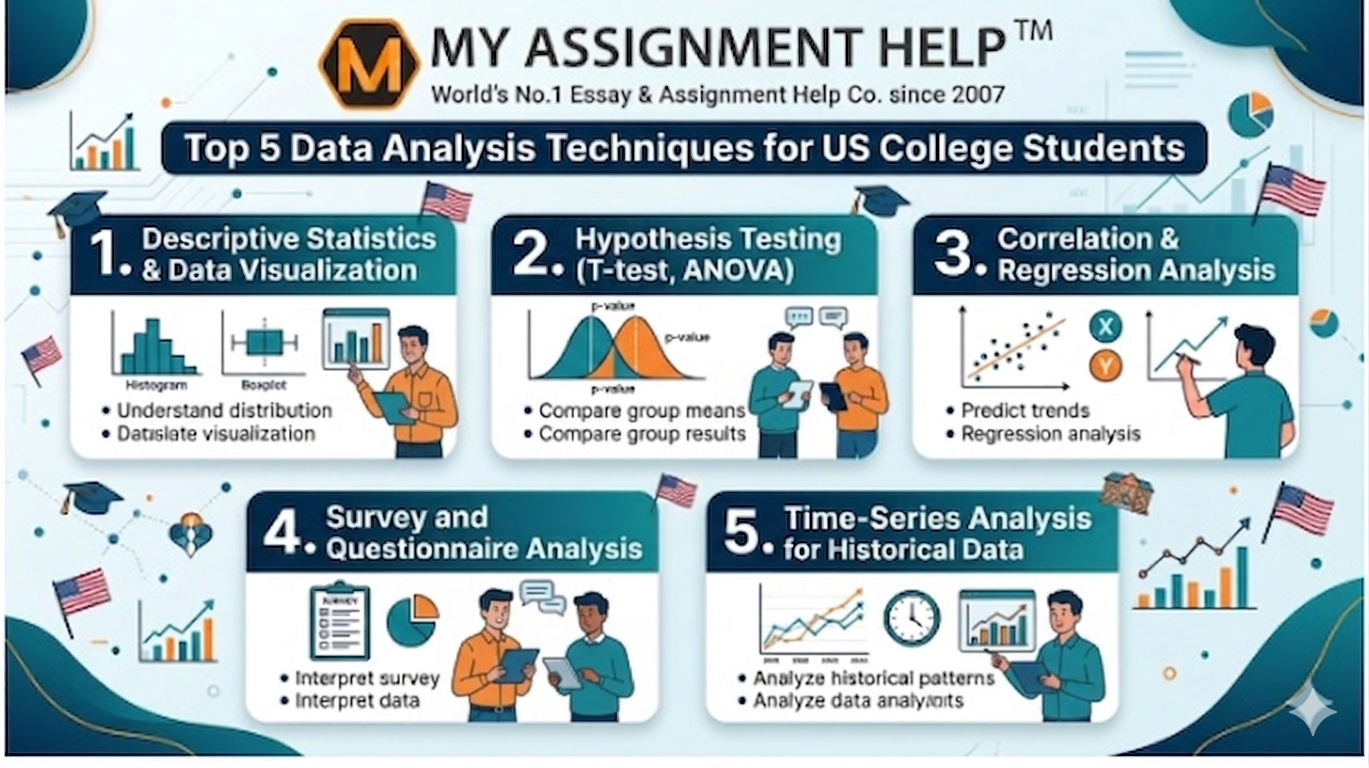
Mastering the Numbers: Top 5 Data Analysis Techniques for US College Students
In the modern American academic landscape, data is no longer confined to the realms of mathematics and computer science. Whether you are studying Sociology at NYU, Economics at UChicago, or Public Health at UCLA, the ability to interpret complex datasets has become a foundational literacy. According to recent reports from the National Association of Colleges and Employers (NACE), analytical and quantitative skills are consistently ranked among the top attributes employers seek in college graduates across all sectors.
However, the transition from theoretical classroom concepts to practical application is often steep. With the rise of “Big Data,” students are expected to move beyond simple averages and dive into predictive modeling, Bayesian statistics, and logistical inference. Mastering these techniques doesn’t just improve your grades; it future-proofs your career in an increasingly algorithmic job market where data-driven decision-making is the standard.
The Bridge Between Theory and Practice
Navigating the rigors of advanced statistics can be overwhelming, especially when balancing a full course load and extracurricular commitments. Many students find that seeking professional guidance, such as data analysis assignment help, allows them to grasp the nuances of software like R, Python, or SPSS more effectively. By understanding the underlying logic of these techniques through expert walkthroughs, you can transform raw numbers into compelling narratives that drive academic and professional success.
Building this technical foundation requires time and consistent effort. However, the pressures of the US higher education system often result in overlapping deadlines and high-stakes finals. When the complexity of multivariate modeling or stochastic processes becomes too much to handle, opting to do my homework via specialized academic services can provide the structural support needed. This allows students to maintain a high GPA while gradually mastering the skills necessary for the professional world.
1. Regression Analysis: Predicting the Future
Regression analysis is the cornerstone of predictive modeling. In the US, this technique is widely used in economics and social sciences to determine the strength and character of the relationship between a dependent variable and one or more independent variables.
- Simple Linear Regression: Used to understand the relationship between two variables (e.g., how study hours affect GPA).
- Multiple Regression: Analyzes how several factors (e.g., sleep, diet, and study time) collectively influence an outcome.
Why it matters: According to Harvard Business Review, regression is one of the most critical tools for making data-driven decisions. For a student, mastering this means being able to forecast trends and justify hypotheses with statistical significance in a thesis or capstone project.
2. Monte Carlo Simulation: Managing Uncertainty
Originating from the Los Alamos National Laboratory, the Monte Carlo method is a mathematical technique that allows researchers to account for risk in quantitative analysis and decision-making by simulating various outcomes.
- The Process: It involves running thousands of “what-if” scenarios to determine the probability of different outcomes.
- Application: Finance students use it to predict stock market fluctuations, while engineering students use it to test the reliability of structures under variable stress.
3. Factor Analysis: Simplifying Complexity
College students often deal with massive datasets containing dozens of variables. Factor analysis helps “condense” these variables into a smaller number of “factors” to reveal hidden patterns.
- Example: If a psychology student is conducting a survey with 50 questions about anxiety, factor analysis can group those questions into core categories like “physical symptoms,” “cognitive patterns,” and “social triggers.”
- Benefits: It reduces redundancy and makes the data much easier to interpret and visualize for peer-reviewed submissions.
4. Content Analysis: Quantifying the Qualitative
Not all data is numerical. For students in the Humanities and Liberal Arts, Content Analysis is a vital technique used to make replicable and valid inferences by interpreting and coding textual or visual material.
- The Method: By systematically evaluating texts (documents, oral communication, or graphics), students can convert qualitative data into quantitative insights.
- Relevance: It is widely used in US political science departments to analyze presidential speeches or media bias during election cycles.
5. Cohort Analysis: Observing Changes Over Time
Cohort analysis involves breaking data into related groups (cohorts) rather than looking at all users or subjects as one unit, providing a more granular view of behavior.
- The Technique: You observe a specific group of people who share a common characteristic over a set period.
- Academic Use: Sociology and Health Science students use this to track how specific generations (e.g., Gen Z vs. Millennials) respond to different stimuli or environmental changes over several years.
Key Takeaways for Students
- Data Literacy is Universal: These techniques apply across all majors, from STEM to the Arts.
- Software Proficiency: Familiarize yourself with tools like Tableau, Stata, or Python (Pandas) to implement these techniques.
- Focus on E-E-A-T: When writing your reports, ensure your data sources are credible (e.g., Pew Research Center, Bureau of Labor Statistics).
- Avoid Overfitting: In regression, ensure your model isn’t so complex that it loses its predictive power for new data.
Comparison of Analysis Techniques
| Technique | Primary Use | Best For… |
| Regression | Finding Relationships | Economics, Science |
| Monte Carlo | Risk Assessment | Finance, Engineering |
| Factor Analysis | Reducing Variables | Psychology, Marketing |
| Content Analysis | Analyzing Text | Journalism, Political Science |
| Cohort Analysis | Tracking Trends | Sociology, Public Health |
FAQ Section
Q1: Do I need to be a math genius to learn data analysis?
No. Most modern data analysis is done using software. The key is understanding the logic behind the technique and how to interpret the output, rather than performing manual calculations.
Q2: Which software is most used in US Universities?
For social sciences, SPSS and Stata are common. For business and data science, Excel (Advanced), R, and Python are the industry standards.
Q3: How can data analysis improve my resume?
Listing specific techniques like “Multivariate Regression” or “Sentiment Analysis” makes you significantly more competitive for internships at top firms like McKinsey, Google, or JP Morgan.
About the Author
Dr. Aris Thorne is a Senior Academic Consultant at MyAssignmentHelp. With a Ph.D. in Applied Statistics from a leading US research university, Dr. Thorne has spent over a decade helping students navigate complex quantitative research. He specializes in helping students apply high-level statistical models to real-world datasets, ensuring their work meets the highest standards of academic integrity and E-E-A-T principles.
References & Data Sources
- National Association of Colleges and Employers (NACE): Job Outlook 2026 Report.
- U.S. Bureau of Labor Statistics: Occupational Outlook for Data Scientists.
- Harvard Business Review: A Refresher on Regression Analysis (Updated 2025).
- Pew Research Center: Data Literacy in the Digital Age.